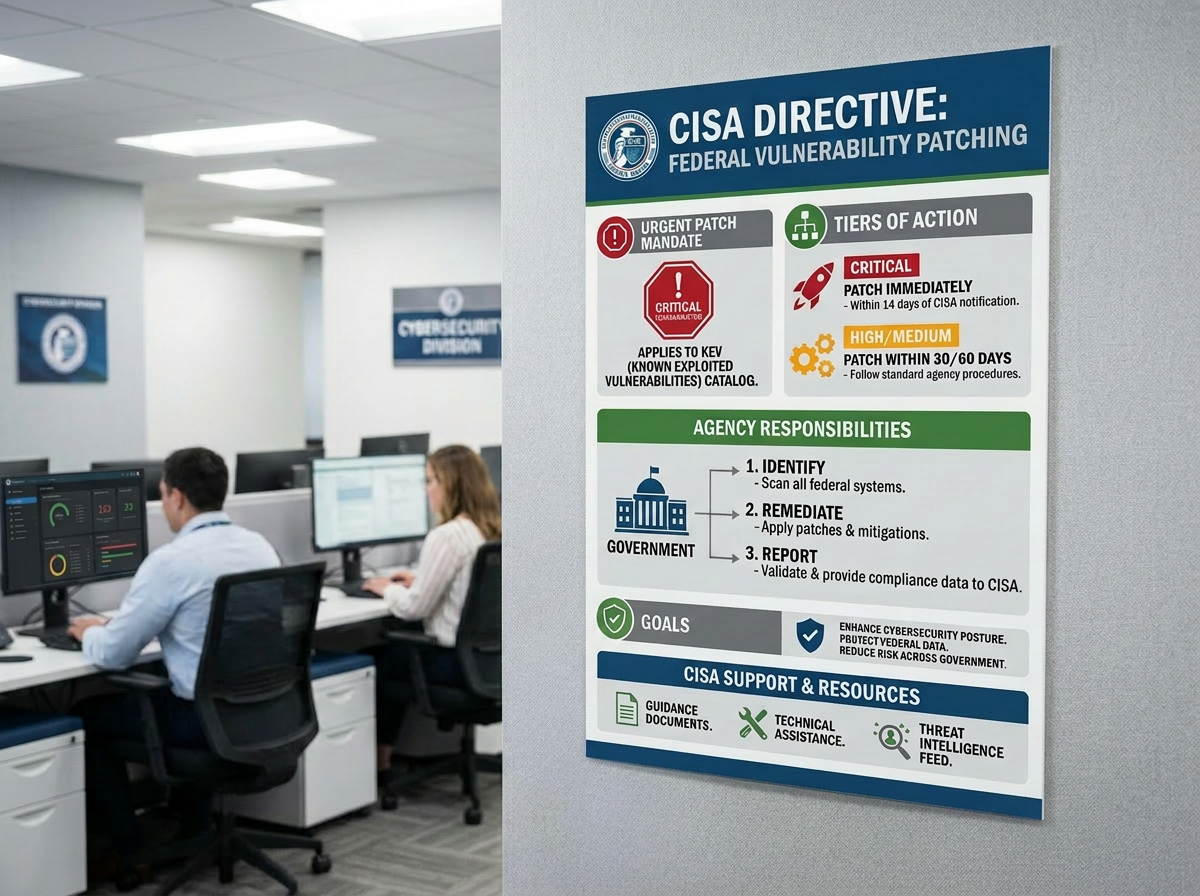
CISA Issues BOD 26-04, Shifting Federal Vulnerability Management to Risk-Based Patching
The U.S. Cybersecurity and Infrastructure Security Agency has issued Binding Operational Directive 26-04, titled “Prioritizing Security Updates Based on Risk.” Released on 10 June 2026, the directive changes how Federal Civilian Executive Branch agencies prioritise vulnerability remediation by moving away from broad, one-size-fits-all patching timelines and towards a more targeted, risk-based model.
BOD 26-04 builds on and updates earlier federal vulnerability management requirements, including BOD 19-02 and BOD 22-01. Its central aim is to help agencies focus their limited remediation resources on vulnerabilities that pose the greatest real-world risk, rather than treating all vulnerabilities or all severity scores equally.
Under the new directive, agencies must assess vulnerabilities using four main risk criteria:
1.Asset Exposure – whether the vulnerable asset is publicly exposed.
2.Known Exploited Vulnerabilities Status – whether the vulnerability appears in CISA’s Known Exploited Vulnerabilities catalogue.
3.Exploit Automation – whether an attacker can automate the steps needed to exploit the vulnerability.
4.Post-Exploitation Technical Impact – whether exploitation gives an attacker partial or total control of the affected asset.
This approach represents a significant shift from relying mainly on CVSS severity scores. While severity remains useful context, CISA’s new model places greater emphasis on exploitation evidence, public exposure, attacker capability and the likely impact of a successful compromise.
One of the most important parts of BOD 26-04 is its tiered remediation model. The highest-risk vulnerabilities — those that meet the most dangerous combination of criteria — must be remediated within three calendar days. These cases also require forensic triage to determine whether the affected system was already compromised before the patch or mitigation was applied.
That forensic requirement is important because applying a patch does not necessarily remove an attacker who has already gained access. CISA specifically highlights the need to check for existing compromise in designated high-risk scenarios so agencies do not mistakenly assume that patching alone has fully resolved the threat.
The directive also allows for longer remediation windows for lower-risk vulnerabilities. Depending on the combination of risk factors, remediation timelines may extend to 14 days, 60 days, or in the lowest-risk cases, be deferred until the next scheduled major system upgrade. This gives agencies a more practical way to prioritise urgent threats without overwhelming IT and security teams with unnecessary emergency patching.
CISA also links the directive to the changing threat landscape, including the role of artificial intelligence in accelerating vulnerability discovery and exploitation. The agency warns that threat actors’ use of AI may further reduce the time defenders have between patch release and potential exploitation. As a result, agencies are being pushed to act faster on vulnerabilities that are both exploitable and exposed.
Recent additions to CISA’s Known Exploited Vulnerabilities catalogue show how the new model is being applied. CISA added Ivanti Sentry CVE-2026-10520 to the KEV catalogue on 11 June 2026, with a federal due date of 14 June 2026. This vulnerability is an OS command injection flaw in Ivanti Sentry that can allow a remote unauthenticated attacker to achieve root-level remote code execution in certain exposed configurations.
CISA also added Oracle PeopleSoft Enterprise PeopleTools CVE-2026-35273 to the KEV catalogue on 12 June 2026, with a federal due date of 15 June 2026. This is a missing authentication vulnerability that could allow an unauthenticated attacker to take over affected PeopleSoft Enterprise PeopleTools systems.
These examples underline the urgency behind BOD 26-04. The directive is designed to ensure that agencies act quickly when a vulnerability is known to be exploited, affects an exposed asset, can be exploited at scale, and could lead to serious compromise.
For federal agencies, BOD 26-04 will require updates to vulnerability management policies, stronger asset visibility, better tracking of publicly exposed systems, and more consistent use of CISA’s KEV catalogue and related vulnerability metadata. Agencies will also need to improve their ability to determine whether vulnerable systems were compromised before remediation.
Although BOD 26-04 is mandatory for Federal Civilian Executive Branch agencies, its impact is likely to extend beyond the federal government. Private-sector organisations, critical infrastructure operators and government contractors may treat the directive as a benchmark for modern vulnerability management. Security teams that already use continuous asset discovery, exposure management and risk-based prioritisation will be better positioned to align with the model.
Tenable and other security organisations have described the directive as a major shift towards risk-based vulnerability management. The key message is clear: organisations should patch based on real-world risk, not just severity scores. The most dangerous vulnerabilities need immediate attention, while lower-risk issues can be managed through planned remediation cycles.
BOD 26-04 marks an important evolution in federal cybersecurity policy. By combining asset exposure, exploitation status, exploitability and technical impact, CISA is giving agencies a more practical framework for deciding what to fix first. In an environment where attackers can move quickly and exploitation timelines continue to shrink, that prioritisation is becoming essential.
Sources
https://www.cisa.gov/